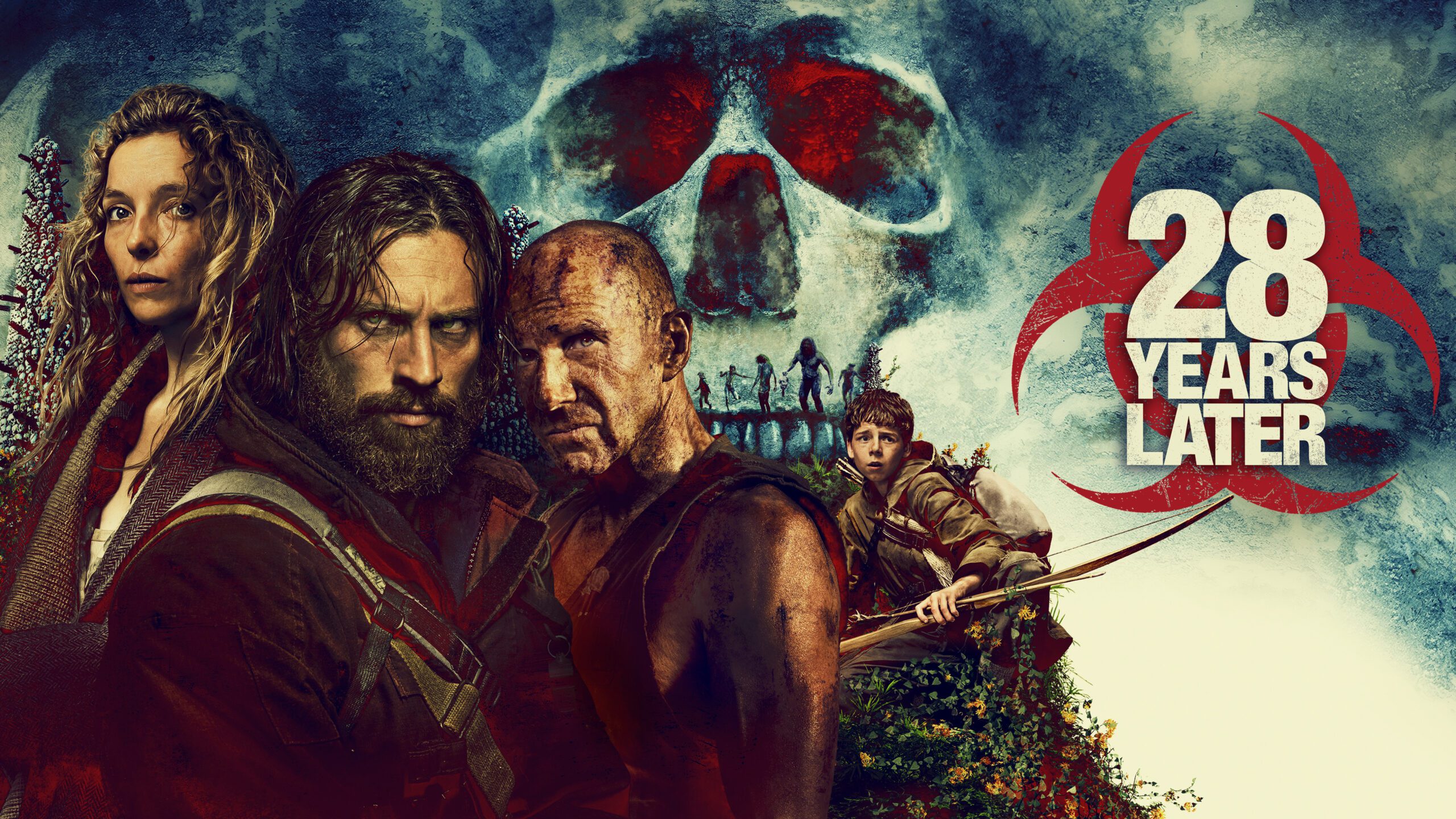
Starring: Jodie Comer, Aaron Taylor-Johnson, Ralph Fiennes, Alfie Williams
Writer: Alex Garland Director: Danny Boyle Year: 2025 Runtime: 1h 54m Rating: ⭐⭐⭐
28 Years Later is the third film in the 28 Days Later franchise. As with the 2002 original, the movie reunites writer Alex Garland and director Danny Boyle.
The movie stars Jodie Comer, Aaron Taylor-Johnson and Ralph Fiennes, while introducing audiences to child actor Alfie Williams, perhaps one of the most promising newcomers of 2025.
Reanimated
2002’s 28 Days Later was THE defining horror movie of the early 2000s, reinvigorating the zombie genre (for better and for worse), while launching the careers of Cillian Murphy and Naomie Harris.

The 2007 follow-up, 28 Weeks Later, however, was as forgettable as its predecessor was memorable.
Despite an interesting premise and a cast that included Robert Carlyle, Jeremy Renner and Idris Elba, it had nothing close to the impact of 28 Days Later, cinematically, culturally or critically.
It didn’t help that writer Alex Garland and director Danny Boyle were not involved in the project, working together instead on the 2007 sci-fi movie Sunshine.
28 Years Later reunites Boyle and Garland though a lot has changed in our culture in the interim.
For one thing, we’re a lot more suspicious and fearful now, thanks in no small part to another virulent outbreak spreading infection and rage.
And with global politics as they are, and the sense that we’re all staring down the barrel of a third world war, a zombie apocalypse seems comparatively quaint.
It doesn’t help that Danny Boyle is clearly more interested in showing us pretty landscapes than he is in scaring us, which is why I spent a good chunk of the movie thinking, “That looks like a nice zombie apocalypse to retire in.”
Boyle Sports
28 Days Later was an era-defining classic, a mesmerising, cinematic chimaera which held audiences spellbound from beginning to end, before lingering in our minds for months and years thereafter.
It was hugely influential in our culture, though it also meant we were inundated with zombies for more than a decade. In fact, the popularity of shows like The Last of Us is a testament to 28 Days Later’s enduring legacy.
I also want to mention John Murphy’s incredible score for the movie, in particular that unforgettable piece from the final scene, “In the House – In a Heartbeat”, forever enshrined in the pantheon of horror movie theme greats alongside Mike Oldfield, Goblin and John Carpenter.
The 2007 follow-up up, 28 Weeks Later, was a massive disappointment. Despite a few decent ideas and a couple of interesting set pieces, the plot was terrible and the characters idiotic.
Odds are you don’t remember so here goes; Begbie’s a pussy and his kids get everyone killed. That’s the plot.

I won’t deny that watching a post-zombie apocalyptic London occupied by US forces was visually impactful. But as with all US occupations of the early 2000s, the mission was a massive failure on every front. (Oh yeah sorry, spoiler alert, the US military is overly trigger happy yet ultimately incompetent.)
28 Weeks Later remains one of the great cinematic what-ifs of the early 2000s – what if Danny Boyle and Alex Garland worked on the sequel instead of the equally-forgettable Sunshine?
Having not worked together since Sunshine, the pair have reunited at last, which is why I decided to go see it 28 Years Later on the big screen.
Alas, no John Murphy this time around, but I think it was a smart career move on his part not to do this one and go for that superhero money instead by scoring Superman.
(Of the various rambling lots-of-great-ideas-but-little-cohesion, established IP reboot-adjacent movies set in a parallel universe released this summer, it’s proving to be the most successful.)
28 Years Later begins with a flashback to the 2002 outbreak and the horror comes fast as we’re forced to watch Teletubbies while zombies swarm outside.
Oh, so this kid we meet, he’s going to be the main character right?
Nope!
Because instead of the action-packed urban hellscape the movie just set up, Danny Boyle gets medieval on our ass by dumping us on an island of tedious villagers.
We also learn that 28 years after the initial outbreak, all attempts at reversing the situation have been abandoned, and the British Isles are now under a strict international quarantine. (Us poor Irish get lumped in with them as usual, fucking typical!)
The plot, such as it is, consists of two main story arcs, both revolving around a young boy named Spike.
In the first story, Spike goes on his first “hunting” trip with his dad, a rite of passage for young men, as they cross the bridge to the mainland hunting Infected with bows and arrows.
Spoiler alert – it doesn’t go quite according to plan.

In the second story, Spike risks further Infected attacks by taking his sick mother to the mainland, all in the hope that he can bring her to see the mad doctor, played by Ralph Fiennes.
Along the way they briefly encounter a Swedish soldier, the last survivor of a naval patrol team who got accidentally marooned in England.
And once again Boyle teases us with the premise of a much more entertaining movie – exactly the kind of movie I imagine most audiences would have preferred.
Which brings me to the main issue with 28 Years Later.
I didn’t dislike it. In fact, there’s a lot to love about this movie.
There’s plenty of tension and lots of clever ideas throughout, plus one an amusing interaction with the Swedish soldier which made the entire cinema laugh in unison.
And forget all this hype about iPhones and grungy footage (yes, it’s there), what you don’t hear much about are all the stunning wide shots, the landscapes, the care and love Boyle puts into capturing locations which include lush forests and ancient ruins.
These are the moments of the movie which stood out most for me, speaking directly to my pagan soul.
But then there’s the other stuff, the weird camera effects more suited to an art student project, the oddball musical choices, the ropey CGI smeared onto landscapes for no apparent reason, the Jason Borne shaky cam sections when all they’re doing is walking through a grey miserable village…
Actually let’s discuss the village, and the bizarre decision to splice in old movie and newsreel footage into the first five minutes of the movie in a haphazard Natural Born Killers style.
This footage comes out of nowhere, appears relentlessly for five minutes, then abruptly stops.
It’s like Boyle had the idea half-pissed, blacked out in the editing room and subsequently forgot about it before handing in the final footage to the studio.
I also can’t get past the end sequence, which is utterly divorced from the style of the rest of the movie, once again giving us the sense that Boyle didn’t really want to make the movie and has been trolling us the whole time.
Most frustrating of all though, is how we’re introduced to lots of clever concepts in swift succession, but there’s never any follow-through.
For example, due to the quarantine, the British Isles live in a state of arrested development, the survivors living a pastoral lifestyle, cut off from technology for almost three decades.
Older generations can still remember early 2000s tech, with rudimentary broadband (well, not in Ireland obviously) and first-generation picture phones, while their children only know about these things anecdotally.
Meanwhile, the rest of the world goes on, with iPhones and 5G.
It’s an amazing premise, with fertile ground for an entire series, but is only mentioned in passing and never explored further.
Any executwats reading by the way? Want to expand the franchise? Let’s do it!
Hell, I could write you a 16-episode miniseries set in Ireland right now, complete with roving tracksuit skangers in Mad Max hatchbacks scooped off the streets and happy to work for six-packs, and for you, a slew of Irish government tax credits and kickbacks.
A smaller island, lower population, but less militarised, less wilderness, more farmland…
Limitless possibilities to explore – come on Hollywood, let’s make it happen!
So, on the off chance you’re a studio exec reading this, let me know and you’ll have the first draft on your desk Monday morning.
No need to involve Boyle either, I’ll do it cheaper and keep the camera steady, plus I promise it’ll have a lot more zombie-related action than this movie.
Which isn’t all that difficult, really.
28 Days Later was a fresh franchise in the making, Alien-level terror, ripe for endless sequels and spinoffs with a perfectly formed movie monster and a ready-made sandbox to tell countless stories.
Perhaps that’s what’s coming next, but Boyle decided he wanted to make an artistic statement instead.
Which I guess is commendable. If only he knew what that statement was.
But while Boyle gets low marks for execution, I have to admire the effort.
Instead of another phone-it-in sequel, Boyle opted to push the envelope visually with inventive camera angles, edits and shot compositions – well half the time at least.
The shots that work, work quite well. Others though, they really hurt my brain.
Strip all the visual stuff away, however, and you have a story that’s underwhelming compared to what’s come before it – even the shitty 2007 sequel.
The Good:
Locations: I have a thing for slow-burn movies, movies which take advantage of natural locations, where shots linger, giving us a chance to breathe in the air.

We get a lot of this in 28 Years Later, particularly in the second half of the movie, which might explain why I left the cinema feeling satisfied despite this movie’s multitudinous flaws.
Alfie Williams: The young actor who plays Spike is a future star in the making. It’s so easy for movies like this to have the token “annoying kid” character (the type of kids we want the dinosaurs to eat in Jurassic Park movies), but instead we have a young actor capable of incredible range and nuance that I’m deliberately giving him top billing here, directly above the legendary…
Ralph Fiennes: Fiennes is an actor who elevates everything he’s in and his character serves as a perfect coda to an otherwise rudderless movie. If you squint really hard, you may even see a theme.
Throughout the movie, Fiennes is built up to be this deranged hermit, gathering dead bodies and piling them up… We get hints that he might even be a cannibal. But it’s yet another example of how this movie loves to subvert expectations.
Instead, we get a performance of raw pathos that’s far more philosophical in nature.
The Bad:
A Meandering Script: I want to reiterate, I normally don’t mind movies which just… wander.
In fact, many of my favourite movies don’t have a storyline in the classic sense and are often just journeys from A to B – most of these seem to have been made in the 70s, come to think of it.
In fact, strip away all the iPhone hype and what you’ve got is a movie that could well have been made in the 70s. It has that avant-garde, pre-blockbuster vibe.
Only problem is, with Alex Garland on writing duties, I was expecting a little more depth and character development, not to mention deeper world-building.
This is the man who gave us classics like Ex Machina and Dredd – two of my favourite movies in recent years.
Whereas this feels more like he met Boyle in a pub, scribbled out some ideas on a beermat then handed them to Boyle, who then went, “Aye that’ll do, cheers pal!”
The movie raises a lot of questions then refuses to answer them – so many missed opportunities.
Weird Directorial Choices: Again, this is one of those things I feel conflicted about. I want to be applauding the experimental nature of this movie.
I want to admire the balls on Boyle for subverting what ought to have been a summer franchise zombie flick and replacing it with a paganistic meditation on the nature of mortality.
But there were too many weird directorial choices, particularly in the first half of the movie, which didn’t sit right with me.
The British:
And We Thought Brexit Was Bad: Wait, so we’re quarantined too? How the hell did the Infected get over here? On a ferry? There’s no land bridge to Ireland, so why are we quarantined?
Bah! Once again, the Brits have fucked us over. First we had Cromwell, then the Famine, Partition, Thatcher, Brexit and now zombies …right, pour me a whiskey and where’s my Wolfe Tones LP!
Because it’s all their fault, because everything’s always their fault, especially when it isn’t! But especially when it is!
Memorable Moments

- Fiennes’ Shrine: One of the most striking features of the movie, both visually and thematically, this towering ossuary is both chilling and ornate while also representing the closest thing this movie has to a theme.
- Go On Home, Swedish Soldiers: I wanted to see more of this, a survival story set in that exact same location; a small group of soldiers fighting for their lives against waves of attacking zombies, how cool would that be? I assume that’s also what the studio thought they were getting.
- Fat Zombies: Sounds more like a middle-aged White Zombie tribute act, but if you’ve seen the movie, you’ll know better. These grotesque creatures sure do make an impact. Once seen, they can never be unseen. Same goes for the buck nekkid infected “Alpha”, who I christened Knob Zombie.
28 Verdicts Later
I’m giving this 3 stars because we don’t yet have half-star emojis.
I guess I need to reimagine this whole star rating thing because this has been a controversial three-star summer.
28 Years Later has a meandering plot and a frustrating script with lots of great ideas and zero follow-though.
And, despite some great performances from core characters, it’s the characters on the periphery of the movie I’d much rather see.
Visually, it’s skitz, with some of the best and worst cinematography I’ve ever seen, often in the space of ten seconds.
The beginning of the movie randomly uses obscure angles and throws in frames from vintage movies for no apparent reason. (Seriously, what’s with all this bow and arrow shit?)
While the second half features beautiful location shots and a more meditative style, occasionally ruined by clunky CGI.

Combined, it left me with a weird feeling, as though I’d seen half of something really special and half of another movie which was utter bollocks.
So, not for the first time this summer, I’m left with a dilemma – how do I grade this?
28 Years Later is a franchise movie trying desperately not to be a franchise movie, and I want to commend Boyle for trying something different.
While I’m not sure how it got made, I’m still glad this movie got made, because we need more weird movies, especially on the big screen.
But I also want more zombies and guns.
And if all you want is zombies and guns, you’ll invariably hate this movie.
If you enjoy experimental cinema, you will find plenty here to enjoy but still, you’re bound to get just as frustrated by it as I was.
28 Years Later is a big, wobbly, mad druid of a movie. A memorable experience, to be sure, but it’s a coinflip as to whether you consider the experience a positive or negative one.
As with the last Mission Impossible movie, I’m glad I went to see it in the cinema, but I doubt I’ll ever watch this movie again.
And this has become an infuriating trend for summer 2025, movies that are great in places, terrible in others. So it all just starts to look very average.
And if the industry doesn’t address this issue soon, the studios will end up like those fat zombies, bloated, lumbering beasts crawling on their bellies in search of sustenance.
Similar Viewing
28 Days Later (2002): Look, this one’s a no-brainer. Just watch the original, which tops the franchise in terms of overall quality, character, claustrophobic scares and moments of unexpected beauty.
The opening scene in a completely abandoned London is still one of the eeriest and most evocative set pieces ever put on screen.
Equally atmospheric is the soundtrack, which includes pieces by Brian Eno, alongside the original score by John Murphy.
Still one of the best horror movies of the 21st century.
Leave a Reply