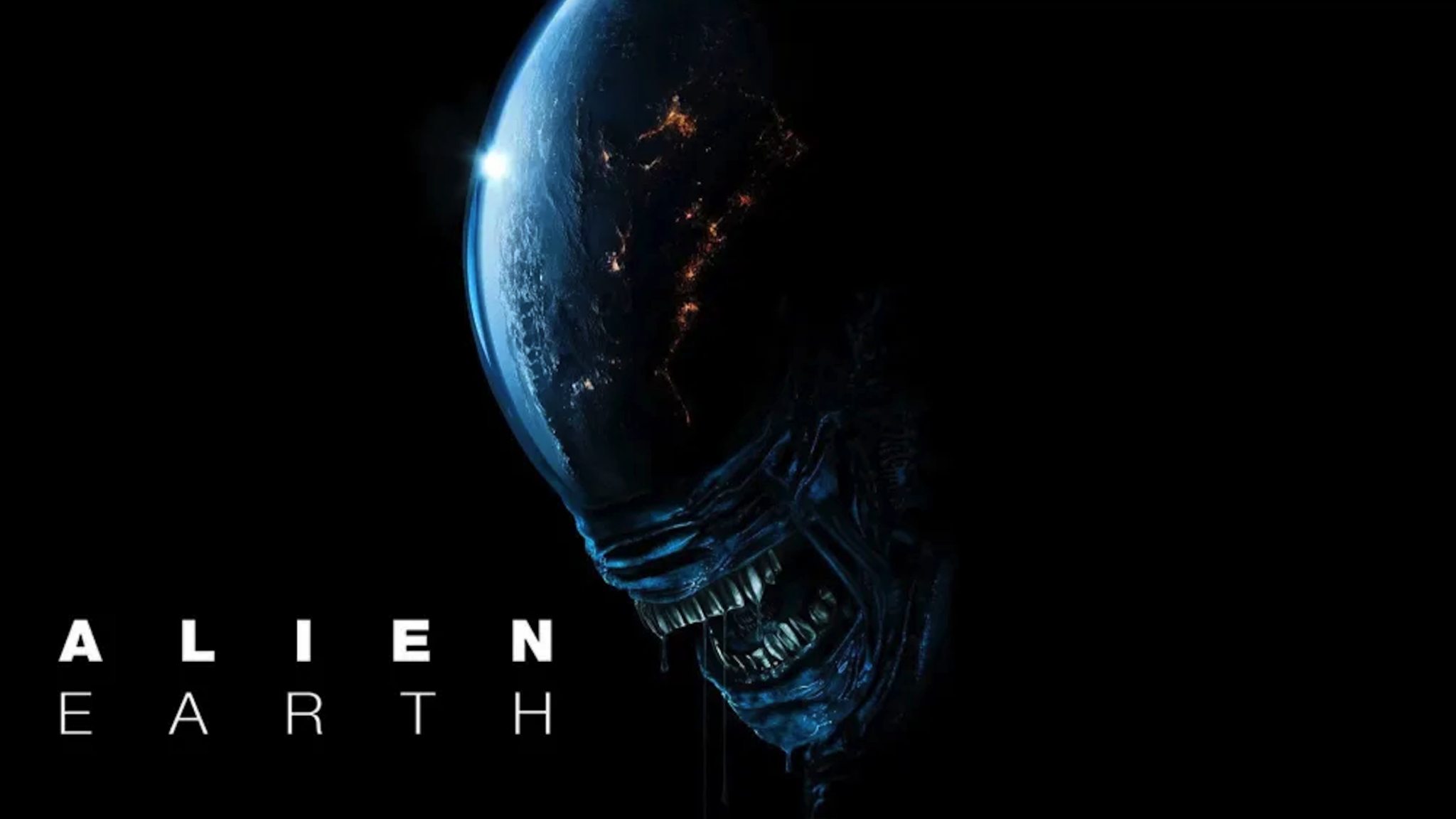
Starring: Sydney Chandler, Samuel Blenkin, Alex Lawther, Babou Ceesay, Adrian Edmondson, Timothy Olyphant
Created By: Noah Hawley Year: 2025 Episodes: 8 Rating: ⭐⭐⭐⭐
Alien Earth is a 2025 series which expands the classic sci-fi Alien franchise by adding new characters, new creatures, new companies and, best of all, a whole new backstory.
Taking centre stage is Sydney Chandler as Wendy, a “hybrid” consisting of the digitised, AI-enhanced mind of a child, uploaded to a synthetic body, who develops a curious connection to the xenomorphs.
Samuel Blenkin stars as her creator, the Prodigy Corporation CEO Boy Kavalier, while Alex Lawther stars as her brother Joe.
Alongside the new hybrids, we have Babou Ceesay as the single-minded cyborg Morrow, and his synthetic rival Kirsh, played by Timothy Olyphant.
Also starring is Adrian Edmondson as Kavalier’s right-hand man, Atom, delivering a chilling performance that’s in stark contrast to his best-known comedic roles.

Stop Your Grinnin’ And Drop Your Linen
Right, so the new Alien show. Fine, I thought, I’ll give it a go.
But first I’ll put on the kettle and make myself a cup of tea.
Cuz I’m rock and roll like that.
Thing is, when I make tea, I tend to let the bag sit for a while, so it’s nice and strong.
Cuz again, I’m rock and roll like that.
So I prepared my tea, gotta let your bag hang, let it just sit there, give it time to brew.
Ok, let’s see what we can see? Everybody online…?
First impressions – not good.
Keep in mind, I’m still processing my trauma from Alien Romulus. That movie started promising, so I allowed myself to feel hopeful, only for those hopes to be dashed midway through thanks to a series of clunky fanboy references and shameless call-backs to earlier movies.
So, when Alien Earth opened with an almost shot-for-shot homage to 1979’s Alien (with an almost note-for-note score to match), my first impressions were not positive.
Here we go again, I thought, more Aliens-branded “content” that’s trying WAY too hard to remind us of the original movie.
And given how Romulus left me feeling cheated and furious, I was ready to bail.
But first… Go back out to the kitchen, get your tea.
So I thought, ok, fine, give it a chance, finish your tea… Then we’ll see.
Because there’s nothing in life that can’t be fixed with a nice cup of tea.

The New Batch
With sequels, the general rule of thumb is that audiences want more of the same.
Ideally, a lot more, but don’t forget to add some new stuff and expand the world a little to avoid making things feel stale.
The story of James Cameron’s pitch to Fox executives for an Alien sequel has since become the stuff of legend.
Standing in front of a blackboard with the word “ALIEN” on it, he proceeded to draw an “S” at the end, then, following a sufficient pause, drew a line down the middle, turning the S into a dollar sign, “ALIEN$”
Simple, effective – and it worked.
But, when you’ve already turned the chilling singular into an action-packed plural – and quite successfully in Cameron’s case – where do you go next?
The Alien franchise has struggled with that question for decades now.
After more than four and a half decades of chestbuster scenes you kinda get desensitised.
As for the iconic xenomorph, it’s officially as old as I am, and feels it.
(I wonder if its knees hurt too when it stands up too quick? Does it stare in the mirror with the cold realisation that it can’t sprint after victims through dark, claustrophobic spaces like it used to?)
But the solution to fixing the Alien franchise was there all along. One need only look at another monstrous franchise of the era to know what the next logical step should be.
Joe Dante didn’t have the luxury of adding an S to the end of Gremlins, so instead of just offering us more Gremlins, the 1990 sequel, Gremlins 2: The New Batch, offered us more types of Gremlins instead.
Sure, we still had plenty of classic Gremlins running amok, but we also had lots of exciting new ones, every bit as capricious as their forebears, but sporting unique attributes and abilities to differentiate them from what we’ve seen before.

And, to mix things up further, Dante moved the Gremlins from a small town to a large skyscraper. This combination of established and new creatures in an enclosed, hazard-filled environment allowed for some next-level carnage.
The setting in question was Clamp Central. In the movie it was the HQ of a broadcasting multinational, but from a scriptwriting point of view, it was a custom-made sandbox in which to breed mayhem.
Alien Earth should rightly be called Aliens: The New Batch – because, as much fun as it is to watch xenomorphs tearing through terrestrial foliage and soldiers, the new additions to the franchise keep drawing our attention away.
The breakout star of the show has to be the Ocellus, an oddball cephalopod contraption who’s all eyes and menace. Alien Earth’s own equivalent of the Brain Gremlin.
Although we do get to see Aliens running amok in an apartment building briefly, much of the action takes place in Neverland, a private island run by an obnoxious tech bro. (I say this every time, but is there any other kind?)
And, like Clamp Central in Gremlins 2, Neverland is an enclosed corporate space complete with its own bio research lab. There’s also a labyrinth of dark corridors inside and a vast jungle outside – everything a growing xenomorph needs.
So, although the title suggests a specific premise – Aliens running amok on Earth – show creator Noah Hawley has instead provided something unexpected.
Sure, we do get to see Aliens running amok on Earth, but what should be the main event is mere window dressing for a more interesting story.
And while there’s plenty of Alien DNA in this series, it’s spliced together with a broader spectrum of science fiction classics, from the wince-inducing body horror of The Thing, to the sprawling cyberpunk cities and transhuman themes of Bladerunner and Ghost In The Shell.
Also – and I’m relieved to discover I’m not the only one who thought this – in addition to giving off serious Replicant vibes, Sydney Chandler’s Wendy often feels like she would be equally at home in the movie Amelie.

Her appearance, mannerisms, and naive curiosity make me wonder whether that movie was also an influence. (Amelie’s director Jean-Pierre Jeunet had directed Alien Resurrection four years prior, so, y’know, it’s all connected.)
Wendy is a “hybrid”, the digitised mind of a child uploaded into a synthetic body.
She represents the first of a new breed of synthetic lifeforms created by Boy Kavalier, the CEO of Prodigy Corporation, and collectively known as the Lost Boys, one of the many (many, MANY!) Peter Pan references found throughout this series.
Noah Hawley’s decision to make the Lost Boys the main focus of Alien Earth, rather than the xenomorph, has split the fanbase.
The character of Wendy is problematic too, not in the Poor Things sense, but rather because she’s a synthetic Mary Sue with poorly defined superpowers, including being able to hack computers with her mind and communicate with the xenomorphs across huge distances.
Ok, so she has the mind of a child but she’s also an empath, a telepath, a technopath and possibly a psychopath.
But y’know what, I’d forgive all that if we got even a sliver of an explanation as to where her powers come from.
It’s a shame because she’s an interesting character and as we watch her develop, week on week, we soon realise we’ve been anthropomorphising her – and what we’re actually dealing with is a new type of artificial life form whose true motives, like the Ocellus, have yet to be revealed.
Those early scenes with Wendy in particular, and all the non-Alien-related stuff in general, that’s what eventually drew me into the story.
Keep in mind, I was still suffering from post-Romulan stress disorder, which is why Hawley’s extensive Ridley homage at the start almost put me off watching completely.
The sequence on the Maginot spacecraft, while impressive, was trying too hard to look like the 1979 classic.

In hindsight, I now concede that this opening was a stroke of genius, the first of many examples where Alien Earth appears to set up something familiar, only to challenge our assumptions.
And nothing demonstrates this better than episode five, when we return to the Maginot to learn more about its hazardous alien cargo and what caused the ship’s collision course with Earth.
The Maginot episode is a top-tier Alien adventure, albeit one that never misses a chance to subvert our expectations, usurping classic tropes, reframing characters, building genuine tension instead of resorting to cheap jump scares, while employing clever camerawork and subtle misdirection throughout.
It’s everything Alien Romulus should have been and possibly would have been if Fede Álvarez hadn’t been spit-roasted between meddling executwats and relentless Prometheusing of producer Ridley Scott.
On a related note, a sharp drop in IQs has become a recurring motif in the Alien franchise, but it’s never has it been this blatant.

Yes, the Maginot has a saboteur on board, but he’s superfluous due to the staggering level of incompetence displayed by its crew, which includes an apprentice engineer who’s so thick he doesn’t know what the word apprentice means, or the name of the company he works for.
Sure, The Company’s hiring practices have always been dubious, think of Gorman (he always was an asshole) or the prison super on Fiorina “Fury”, nicknamed 85 because the inmates discovered that was his IQ.
And let’s not forget the crew of the Prometheus – run to the side moron! – previously the gold standard for Company stupidity.
But as of 2025, the Maginot crew now takes the incompetence crown, a fitting distinction for a ship named for one of history’s greatest strategic blunders.
Weyland Yutani: Building Better Worlds (By Promoting Incompetence)
The Good:
World Building: There’s only so many times you can watch xenomorphs prowling dark corridors, scuttling along ceilings or descending from air ducts before it gets stale. The time to expand the Alien franchise’s operational environment was WAY overdue.
You have to wonder why it took 46 years, but no matter, Alien Earth has finally shifted the action away from space, making the screams far more audible.
Ever since Ron Perlman’s throwaway line in Alien Resurrection – “Earth man, what a shithole” – I’ve been curious to know what this Company-First version of Earth looks like.
Seeing that for the first time was what drew me into the show and eventually won me over.

The brave choice to expand the world of Alien by adding new lifeforms, both alien and synthetic, may have been controversial, but it also disarmed my initial cynicism and kept me watching.
Production Design: There are more than a few echoes of Andor here, not so much in the aesthetic but in the approach.
There’s a granular level of detail you can see in every step of the production design process, so I’m guessing, as it’s a Disney product, many of the same talented people who gave Andor its retro-70s Star Wars aesthetic also worked on this.
Exhibit A: the design of the Maginot; the pods, med-bays, the computers and control panels, everything right down to the chrome apertures on the specimen jars. The Maginot feels functional and tactile but with a retro 70s aesthetic created to match Michael Seymour’s original 1979 designs.
Compare and contrast this with the tech and fashions from 65 years in the future and the different styles and aesthetics of the companies. All those blink-and-you’ll-miss-it moments, like Yutani’s guards, dressed like red samurai packing assault weapons. (Please let’s see them in action in season two!)
Practical Aliens: One thing which helps this feel connected to the 1979 original is the judicious use of practical effects, especially on the xenomorph itself. Obviously there’s CGI also, but it’s more for blending than rendering.
Whenever possible, the team used practical models and costumes, making a lot of the interactions look more realistic, while still retaining that trademark Alien jankiness we’ve come to love.
Tunes: I’m from the same year as Alien, so no surprise I enjoyed the end credits with classic 90s rock on here from the likes of Metallica, Tool and Pearl Jam. It shouldn’t work in the context of this project, but it does.
The Olyphant In The Room: Kirsh, the synthetic played by Timothy Olyphant, may in fact be the best performance of a synthetic person I’ve seen in Alien so far.

Ian Holm as Ash set the standard, and then there’s Lance Henriksen as Bishop, we all love Bishop. And as for Fassbender’s David, it was a memorable performance for sure – pity the script was shit.
Three great actors, all solid performances, yet none can match the eerie, magnetic detachment Olyphant brought to this role. Even when he’s just standing there in a room full of exotic aliens, he remains our primary focus as we keep asking ourselves, “what’s he up to?”

Dab Hand Eddie: I also want to give props to Adrian Edmondson in a role I could never have predicted. He plays Atom, Boy Kavalier’s personal assistant. Like Olyphant, it’s another a cold, steely performance full of poise and restraint, but always with a simmering undercurrent of malice.
Edmondson’s always been a favourite actor of mine, albeit one I always associate with comedy classics like The Young Ones and, best of them all, Bottom.
Sure, there’s a part of me that would have loved to see him hit a xenomorph over the head with a frying pan, but that urge subsided the more I watched him completely own this role. 👏

And though his comedy roles have always been misanthropic, to put it mildly, this is a much darker side of Adrian Edmondson I’ve not seen before and I want to see more.
That said, let’s not forget the true star of the show…
Octopus Rift: Sure, Alien is the name on the marquee and the xenomorph’s double-jawed mug is on the marketing, but this little fella’s the real star of the show if you ask me.
We learn early on that the xenomorph wasn’t the only creature that Weyland-Yutani wanted to bring back, the hapless Maginot was, in fact, hauling an entire menagerie of dangerous creatures across space to study.
The bulk of these, hideous though they are, are mere monster-of-the-week candidates, bar one standout, the Ocellus.
From the very first episode we suspect there’s more to this creepy cephalopod than meets the eye, or, eyes, depending on its mood.
We enter its perspective, via an inventive kaleidoscopic vision effect, observing the gormless crew as the threat level intensifies.

Dubbed the eyeball monster by fans, the Ocellus doesn’t behave the way the other creatures do. Instead there is a subtle inversion at play.
Observing from behind a glass barrier, we get the sense that the Ocellus doesn’t see itself as the subject, but rather as a behavioural scientist.
From its pan-optical perspective humans are the alien species – and not a particularly intelligent one.
Given the patterns of hubris and incompetence it witnesses, how can it see humans as anything more than primitive lab rats?
The Ocellus’ ascension comes at the expense of the xenomorph itself, both thematically (and in one short scene literally), but the show is stronger as a result.
But I might even have given the show a perfect five stars if we got even the slightest glimpse of the Ocellus’ intentions, or at least some form of payoff at the end.
The Bad
Wait, So That’s It Then? My biggest issue with Alien Earth is how it ratcheted up the tension and curiosity before ending in a massive anti-climax.
All those questions you have, like, “wait, how is she able to do that?” “What’s the deal with the Ocellus, then?” And, “I wonder what’s gonna happen when Yutani’s crew show up?”
Nothing. Not a fucking thing!
Hence a disproportionate number of negative reviews from fans who felt short-changed.
If you’re going to build something up in the beginning, there needs to be a payoff at the end. A reward for our loyalty.
And if you want a cliffhanger for season two, you need to at least partially answer the existing questions before introducing some new ones.
C’mon, it’s fucking scriptwriting 101!!!
Weyland-Idiocracy: We live in a stupid age, of that there is no doubt but it’s nothing compared to what’s coming.
If Alien Earth is to be believed, the future belongs to the incompetent.
I know Weyland Yutani has some abysmal hiring practices, but you don’t expect scientists on a spaceship to be this thick.
The Maginot reminded me of many of my past workplaces. Full of jabbering incompetents, scurrying around, bad-mouthing, back-stabbing and shagging one another when they’re supposed to be doing their job.
There’s also the token creepy guy that every office has, the idiot kid who doesn’t know his arse from his elbow and keeps asking dumb questions, the manager who’s completely checked out and an entire crew of staff who don’t seem to know what they’re doing – how did these people get hired?!
When it all goes to shit – as it inevitably always does with workplace clowns – all that matters is who gets off the sinking ship first.
That’s why I love the character of Morrow. Everyone else hates him, sure, but doesn’t care. Cuz he’s the only guy up there doing his job.
Peter Pan: I get it, I get it. It’s not like it’s subtle, is it? Noah Hawley clearly had a concept in mind while making this show, but the Peter Pan motif is so fucking pervasive that, after two episodes, it becomes unbearable.
The Ridley
Reconned: Did I mention how annoyed I was with Alien Romulus?
Only a couple dozen times, right?
It might have been a good movie before Ridley Scott got his grubby pawprints all over it. From the character of Rook, a deepfake abomination based on Ian Holm, to its ridiculous ending, which attempted to tie it all back in with Prometheus and the Blue Man Group… Sorry, “Engineers”.
All of that put me in a foul mood well before I ever heard about this series.
And when I did hear about it, I assumed it was going to be more of the same, more call-backs, more fan service, more studio micromanaging and behind-the-scenes Ridley fiddling.
Instead, we got a much-needed blank canvas, with new characters, companies, new species, and new lore.
I can somewhat understand the fan backlash, given how far this has strayed from the original.
Alien Earth takes lots of big swings and not all of them connect. In fact some of the swings are as inept as the Maginot crew, but if the upshot is a new Alien history that ignores Prometheus, then I’m down.
Because I hated Prometheus.
And Alien Covenant.
And pretty much everything Ridley Scott has done since Blackhawk Down.
Once a brilliant and visionary director, Ridley lost his way. Like George Lucas, he developed Jar-Jar Brain late in life, an incurable CGI addiction coupled with critical impermeability resulting in a complete lack of focus and reverence for any source material he works on, including his own.

So in a way it’s fitting that the man who rewrote The Crusades and the Napoleonic Wars because “I’m the director”, is himself rewritten out of the franchise that launched his career.
Key Scenes (You Can Never Unsee):
Aliens Versus Predatory Litigators: What can I say, I’m a sucker for class warfare and watching a bunch of wealthy mincing toffs in powdered wigs getting sliced to ribbons by a xenomorph gave me a warm fuzzy glow inside. Hell, if the whole series was just that, I’d be content.
Synths Versus Cyborgs: Such primitive human notions of class warfare no doubt appear obsolete and irrelevant in the world of Alien Earth, as new divisions are emerging.
This is best exemplified by the ongoing expansion-port-measuring contest between Morrow, a cyborg, and his synthetic rival, Kirsh.

One of my favourite scenes in the entire series is a brief discussion between the pair, a mere few seconds in an elevator, but it’s a pointed and memorable exchange.
Sheepish: Alien Earth offers plenty of iconic visuals, but none have resonated as much as the Ocellus-possessed sheep.
After a particularly gruesome attack sequence – it always goes for the eyes first, entering through the eye socket before binding itself to the brain – the “possessed” sheep stands up on two legs briefly, just to prove a point to its captor.
It then spends the next couple of episodes glowering out through the glass at its captors with what can only be described as a Kubrick stare.

Not Just Another Bug Hunt
Living as we are, in the era of malfunctioning artificial persons, you’re certain to find an endless stream of negative reviews for this show.
Some are irked at how it deviates from the original Alien franchise, which I can understand to a certain degree.
That said, let’s not forget all those pre-internet nerds who wrote nasty letters to James Cameron back in the day because he “ruined Alien.”
I mean, that’s certainly one way of looking at it. But such opinions are based on a love of the material, and nothing more. And these people I don’t have a problem with.
Alas, the vast majority of negative reviews are from bots, or might as well be, given how predictable these angry young internet nerds have become.
Their main source of grievance seems to be with the character of Wendy.
As though a strong female characters were not the backbone of the Alien franchise from the beginning.
Aaaah… wait, I get it now. It’s cuzza Disney, right? Cute, cuddly woke-as-fuck Disney.
You know, by the third gruesome alien-related death, I had completely forgotten that Disney had anything to do with this show.
But the legions of braindead culture warriors never rest, with some calling it “Alien Acolyte”.
Sick burn braah!
Except, if anything, Alien Earth is more analogous to Andor, in its level of minute detail, in its ambitious scope, and for daring to explore themes way beyond the existing parameters of the franchise.
And successfully too.. well…

By moving away from deep space and into a broader world of transhumanist concepts, Alien Earth prompts us to consider our own humanity.
Previously, we had three archetypes; workers and grunts at the bottom, the slimy Company men at the top, and the synths doing the dirty work in between.
The xenomorphs, meanwhile, though clearly intelligent, are mere drones, bereft of individuality and exhibiting only the basest of motivations.
Alien Earth adds additional layers of chaos by throwing new lifeforms into the mix, including one which matches, and perhaps even exceeds, human intelligence.
It also builds on the traditional three-tier Terran system by introducing cyborgs and hybrids, both of which threaten the synths’ position as middlemen to the rich and powerful.
Each new episode prompts a cascade of questions; can human consciousness be uploaded to a machine? If so, does that person live on, or do they cease to be a person?

What is a soul? Can it be digitised too? Are the xenomorphs sentient? Is that thing hanging from the ceiling an animal or a plant? Did Temu Molly Ringwald really get impregnated or is she just a wackjob? And where do baby facehuggers come from?
Ok, so we know the last one you should know but as for the rest? We never get any of the answers.
And that’s Alien Earth’s biggest sin.
I’d forgive its manifold problems if it wrapped up at least some of the lingering questions before teasing us with season two.
In the meantime, I wanna see more of The Ocellus.
Parasitic body horror was a key part of Geiger’s original Alien design, but this new creature adds a new cerebral dimension – in every sense of the word.
The Ocellus appears to be a walking brain with 360-degree, high-definition vision.
Like an octopus, we can assume its arms are bristling with hundreds of millions of neurons – perfect for binding with the brains of its hosts.
While the xenomorph’s life cycle is parasitic, the polysemic Ocellus acts more like a hacker whose true motives remain obscured.
We know it’s intelligent. And we know that, given the right host, it’s also remarkably strong.
After all, we watched it take on a fully-grown xenomorph, batting it out of an airlock when it couldn’t find a nice, juicy eye socket to climb into.

So is the Ocellus an alien supervillain in the making? Or just a poor trapped creature trying to survive long enough to escape.
Who can tell?
One minute it seems to be warning characters of danger, then later causing them deliberate harm.
More likely it’s operating in a moral grey area, viewing the different entities around it as pieces of a chessboard while pondering its next move.
I was hoping to see a glimpse of its motivations before the season’s end, but now it looks like we’ll have to wait at least two years to find out.
Until then, what’s the next obvious step in the meantime? Ocellus vs Predator.
I’d watch the shit outa that!
Related Viewing:
You know I’m going for the underdog, right? Last time I went for Star Trek Enterprise.
Well, this time I’m going for:
Alien 3 (1993) Director’s Cut: This movie broke poor David Fincher’s brain – it was his first time in the chair, and the experience almost put him off directing for life. (Luckily for us he changed his mind.)

Alien 3 had all the makings of a great movie, a brilliant (though at the time unproven) director, a decent premise and a solid cast, not to mention one of the greatest movie monsters of all time.
But behind the scenes circumstances ensured this movie was always going to be a shitshow, regardless of the talent involved.
The director’s cut, at least, gives us a better idea of what this movie could have been.
You also get a greater sense of how badly butchered the original theatrical release was.
The director’s cut restores key scenes and, with them, important things like character development, motivation and plot. (Without which it’s just lots of random bald guys running around in the dark.)
Shortly after Alien 3’s VHS release, I managed to buy a cheap ex-rental copy. I watched that video incessantly.
Every subsequent rewatch makes me appreciate this movie more. Even by Alien movie standards, it had a bleak atmosphere which resonated with me at the time.
It was also pivotal in the development of the “Fincher look”, with a grimy, tobacco-stained aesthetic that, even the chain-smoking world of Alien, looks extreme.

32 years on and Alien 3 still gets a lot of hate though I can 100% appreciate why. Killing off Newt was a cheap shot, completely undermining the ending of Aliens.
Worse still, we got no Hicks, barely a Bishop, and little in the way of action because Fury 161 is a prison planet with no guns.
Years later I read William Gibson’s script and wondered what could have been. And I’ve poured over the “monk-punk” designs for the original space monastery concept that got slashed for budget concerns.
If there are indeed parallel universes, I’m sure that every single one of them has a vastly superior Alien 3 to ours, yet I can still appreciate this movie on its own terms.
Sigourney Weaver delivers her best performance of the franchise, full of spiteful tenacity and mournful pathos.
And she looks great too. The choice to shave her head was a brave one, but it works, lending her an androgynous sexuality that’s both feminine and vulnerable, yet tough and severe.
It fits the theme of the movie perfectly, helping bring both sides of her character into extreme focus.
And speaking of extreme focus. Nothing encapsulates the Alien franchise quite like that iconic shot of Ripley in the shower, the xenomorph right beside her, its drooling double jaw extended…
It’s one of the greatest shots in sci-fi movie history and more than makes up for many of Alien 3’s wonky effects.

Weaver’s not the only one giving it her all. Charles S Dutton delivers a standout performance as a violent criminal who “found religion at the ass-end of space.”
His “nobody never gave me nuthin’” speech gives me goosebumps every time.
Yeah it’s cheesy, in the best Hollywood tradition of rousing speeches, but it works because Dutton makes every syllable smack like brass knuckles.
As with its 1986 predecessor, Alien 3 was shot at Pinewood Studios, which is why we’re also treated to a who’s-who of British acting talent, including Pete Postlethwaite, Paul McGann and Charles Dance.
And let’s not forget the late character actor Brian Glover as the snarly warden Andrews.
Incidentally, Brian Glover also played Adrian Edmondson’s neighbour, Mr Rottweiler, in the classic UK comedy Bottom.
So yeah, you can take that as confirmation, Alien, Bottom, it’s all connected.
Hollywood, I know I keep saying this, but if you’re reading I am available for scripts:
#SpudgunVsPredator
Leave a Reply