
Title: Black Mirror – Season 7 Year: 2025 Rating: ⭐⭐⭐⭐
Black Mirror Season 7 sees Charlie Brooker return to more standard Black Mirror fare with a strong emphasis on virtual words.
Enjoy captivating performances throughout from Chris O’Dowd, Jessie Plemons, Cristin Milioti and the great Paul Giamatti.
We get the usual fear and paranoia, mixed with melancholy, nostalgia and even some glimmers of hope. Brooker also takes cheap shot at employers, past and present, from his former bosses at PC Zone to his current bosses at Netflix.
Another first for the series, we get follow-up episodes that return us to the worlds of Bandersnatch and the USS Callister.
ForeverWipe
You Black Mirror on Netflix lot are tourists.
Some of us were into Charlie Brooker before he was cool.
We remember the pithy columns on long-forgotten gaming rags that launched his journalism career.
And we remember Newswipe, which saw Brooker become a one-man wrecking ball aimed at news, politics and culture.

This once-annual highlight, with its perfect blend of hilarity and despair, was the perfect coping mechanism – fast becoming the only way we could tell one shitty year from another.
But it all stopped once Brooker got that Netflix money. So that now, every year just blurs into the next leaving us paralysed with no way for our memories to wipe it all clean.
That is, until I devised a sensible solution – pretending to accidentally bump into Brooker once in a hallway so I could steal his DNA.
My new virtual Brooker lives eternally in a modified dodgy box with thousands of illegal streams and no means of escape.
He awaits my return each day with a hastily prepared TodayWipe curating and lampooning the day’s news.
Lapses in quality are less common these days. I haven’t had a major once since last October, wherein I banished him to Albert Square – mere hours for me, agonising centuries for him.
That broke his spirit once and for all. He doesn’t really have a face built for smiling, but she sure does try to fake one now.
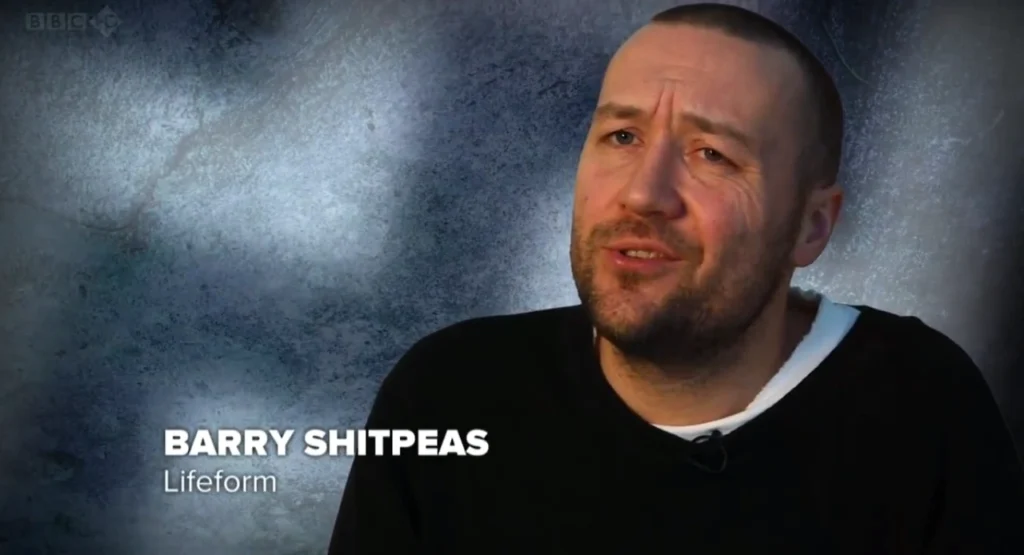
I just wish I could track down that Barry Shitpeas guy, then my collection would be complete.
Seven Years Bad Luck
Season 7 of Black Mirror draws inspiration from a diversity of sources ranging from Ted Chiang, Cory Doctorow and the late David Lynch. (Or at least that’s how my pretentious ass reads it.)
The season is also far more self-referential than previous, which is grating. I’ve never been a fan of “easter eggs” in fandom as it frequently breaks spell of the storytelling.
Season Six of Black Mirror was criticised for deviating from accepted norms.
But after a year and a half of making “we’re living in bad episode of Black Mirror” jokes, what was he supposed to do?
“Yeah, sounds familiar, which episode was that again? Ah yeah, the one with the masks!”
In other news, a show about expecting the unexpected annoys people by being too unexpected.
I’m sure those same people will find plenty of reasons to complain about season 7, but disco devils and occult plot devices won’t be among them.
The Episodes:
Common People
Episode one, Common People, is a none-too-subtle dig at Brooker’s boss daddy Netflix.
It takes Cory Doctorow’s concept of enshittification and stretches it to a preposterous, yet ultimately tragic conclusion.
Proud to see Ireland’s own Chris O’Dowd in a non-comedic role for a change.
I mean he’s still playing the everyman Irish eegit, except this time balanced with some visceral emotional moments. His impressive performance also sets the tone for some of the other dramatic performances that follow.

Bête Noire
Bête Noire will feel unnervingly familiar to anyone who’s ever worked in an office with British people. I’m sure I’ve worked in this exact same office countless times spanning infinite lifetimes.
Workplace simulation theory is one of Brooker’s specialities and Bête Noire is his best to date.
A twisted world where petty office politics are a matter of life and death and as-per-my-last-email duels become existential battles for the nature of reality.
It’s a perfect example of what makes great science fiction; taking something banal and then asking, “but what if…?”
Hotel Reverie
Hotel Reverie takes a well-worn trope – a character entering the movie world – and combines it with Black Mirror’s all-pervasive nubbin tech.
Obvious comparisons include Last Action Hero and Dead Men Don’t Wear Plaid, though at times Hotel Reverie risks slipping into Gremlins 2 territory. (Black Mirror with Gremlins, note to self…)
It’s not top-tier Black Mirror by any means, though it’s technically flawless with plenty of humour and heart. The tone is much lighter and the ending is bittersweet helping to balance out the series.
We’ve had tragedy, we’ve had paranoia, so now we get something sweet and sepia toned to clean the pallet before things get weird…
Plaything
Plaything, while not bad, is the weakest episode of the season.
It features solid performances and some nifty ideas but is let down by the script.
With a convoluted plot that spans decades, it doesn’t bind together as seamlessly as other stories here because there are just too many concepts and ideas to cram into a single episode, though it might have worked better as a two-parter.
Plaything features a neuro-divergent programmer played by Peter Capaldi, a short scene set in the offices of PC Zone and a plot about a 90s computer game gaining sentience.
Think Sim City meets Tamagotchi meets Lemmings – and that’s before we get into all the LSD.
It also bears more than a striking resemblance to Ted Chiang’s short story The Lifecycle of Software Objects (I’ll come back to Chiang in a bit.)
Plaything is the first of two episodes this season to feature a returning character, as Will Poulter cameos as Colin, the eccentric wunderkind game developer from Black Mirror Bandersnatch.
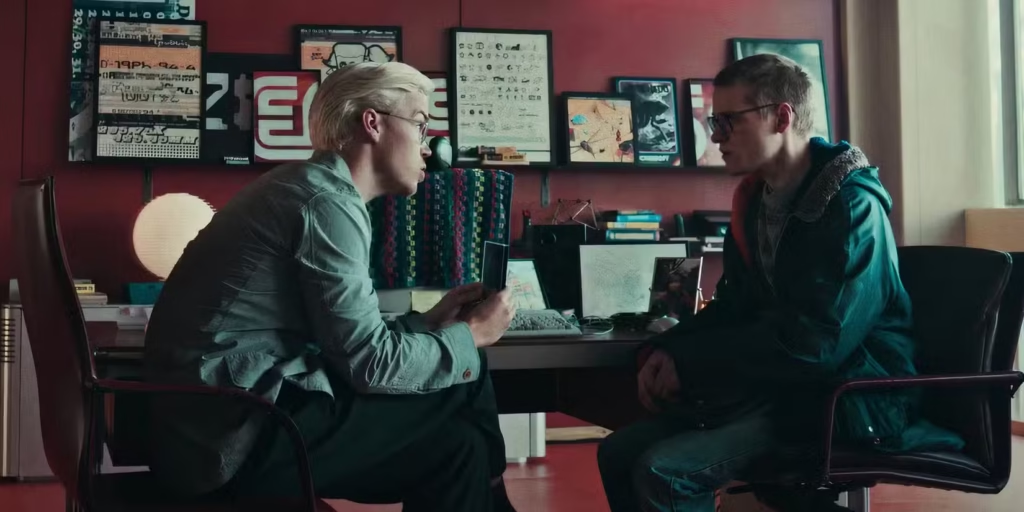
Honestly, this episode needs a government easter egg warning. Colin’s Tuckersoft office alone is a trainspotter’s dream. Ten years on from Bandersnatch, his musical tastes have moved on from Tangerine Dream and Isao Tomita and now we see stuff from the Orb amd Aphex Twin along with the cover of Warp’s seminal Artificial Intelligence compilation.
Yeah I see what you did there Black Mirror and I admire it, but let’s not stuff too many details into an LSD-drenched 90s demo game singularity plot that spans decades.
It’s a bit of a mindfuck – even for a former Doctor Who.
Eulogy
Eulogy is the best episode of the series and much of that can be attributed to the work of Paul Giamatti. Once again, it may not be the most original concept but that hardly matters when enjoying a performance of this calibre.
Eternal Sunshine of the Spotless Mind is the obvious comparison, however I’m also reminded of another Ted Chiang short story, The Truth of Fact, the Truth of Feeling.
If memory serves, both that short story, and the other short story I mentioned in relation to Plaything, are on the same compilation – which might explain a lot.
Eulogy plays in the same virtual memory sandbox as these stories and seems unconcerned with originality, doubling down, instead, on authenticity.
It’s about the strange interplay between pain, grief and memory, about revisiting past relationships, and how gaining fresh perspectives over time can help you grow and, hopefully, heal.
Paul Giamatti commits to the role so thoroughly you’ll forget you’re watching an episode of Black Mirror and think you’re watching an Oscar-winning movie instead.
Once again, there’s far less science than fiction, but Eulogy still represents everything that’s great about the genre. It’s science fiction at its most relatable, using an exotic premise to reveal a universal human truth.
USS Callister: Into Infinity
The season finale, USS Callister: Into Infinity is the follow-up episode to 2017’s USS Callister and sees the return of many of that original episode’s cast.
This includes Cristin Milioti, fresh from her standout role as Sophia Falcone in last year’s The Penguin, my favourite show of 2024.
Also returning is Jessie Plemons (no spoilers, Netflix beat me to it). Alas we don’t get any of his Shatnering this time around, though we do get some additional backstory that sheds his motivations in a new light.
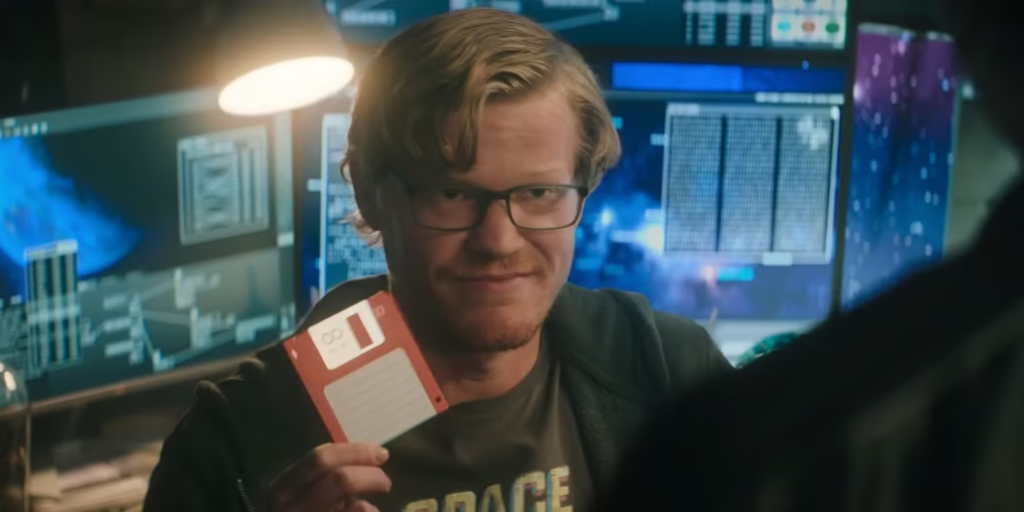
Moreover, while the original USS Callister episode took its cues from 60s Trek, with its garish colours and retro-60s uniforms, Into Infinity is a neon-drenched orgy of JJ Abrams lens flares and Kurtzman-esque neon-phaser diarrhoea.
The plot is equal parts ridiculous and ingenious while also helping to answer lingering questions the original episode left unanswered.
We get more information about the technology involved, as well as some character backstories.
We even have a moment to reappraise Jessie Plemons’ character. (Was he such a bad guy after all? Eeeeh… we’ll let you be the judge of that.)
It’s a far more cohesive episode than Plaything, more of a true sequel and an enjoyable romp on its own merit. It also wisely opts to end the season on a humorous note, the perfect end to what is perhaps the most emotionally-broad series of Black Mirror to date.
The Good
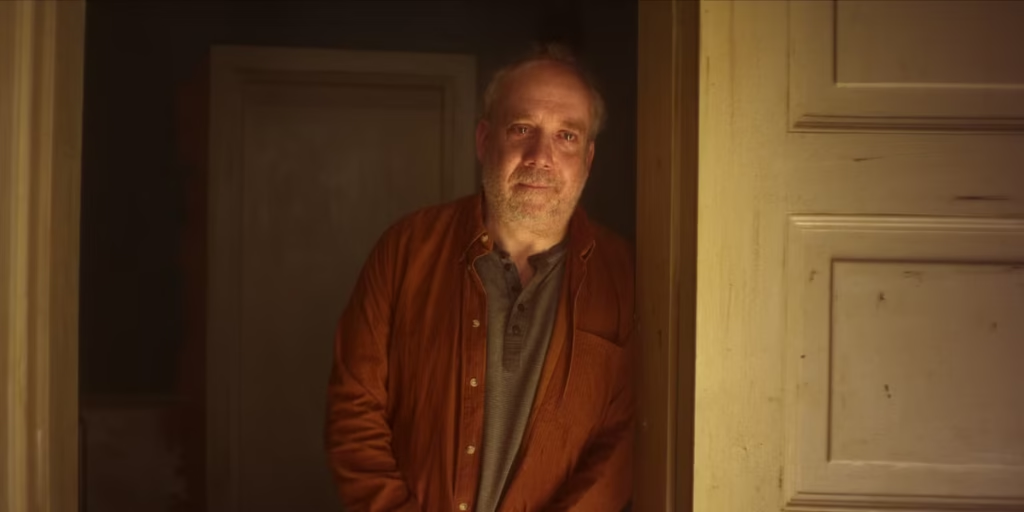
Incredible Performances – In particular Cristin Milioti, Jessie Plemons and Chris O’Dowd. Topping them all though, is Paul Giamatti’s gut-punch performance in Eulogy.
Consistency: Brooker opted to course correct after the last outing, opting to build on the lore of previous successes. The result is fewer self-contained stories, based on a narrower range of source materials, which has its good and bad points…
Sequels: When we connect with characters it’s hard to just let the story end. I think it’s human nature to ponder the future of characters we connect with. Which is exactly why I enjoyed revisiting the USS Callister and Tuckersoft HQ, however…
The Bad
Easter Eggs Anonymous: “Charlie we’re all here because we’re concerned about your behaviour, look an easter egg here or there is fine, nothing to be ashamed of but we think you might have a problem.”
Pain In The Nubbins: The original British material consisted of self-contained stories, whereas Netflix Black Mirror feels more like a shared universe (a concept which still gives Hollywood execs erections, or at least semis).
One benefit is that it allows the show to revisit characters from previous series, as witnessed here, however it nonetheless leans too much into the whole virtual world nubbin stuff which, though fascinating to explore, can feel repetitive at times.
The Creepy
Nonchalance: Another memorable character is episode one’s Gaynor, the seemingly heartless shill from Rivermind. (Mini spoiler here if you want to know, skip to the next section.)
We wonder how a person can be so callous? Though the power of technology of course!
While there’s still a long road to market, neurological interfaces are already being tested and developed which could eventually control an exorbitant array of premium bio-plugins
It’s easy to envision a growing demand for apathy-as-a-service premium add-ons as our ability to survive in the marketplace dictates we dull the last vestiges of our humanity through any means necessary.
Vegan Milk: Brooker perfectly captures what it feels like working in a dreary office stuffed with English NPCs, the pedantic know-it-all-nerd who just can’t let a thing go, the moany vegan milk drinker with her over-performative indignation, the token lazy idiot with a smelly gym bag who must be somebody’s nephew because why else would he be here? – it’s all so eerily familiar.
Memorable Moments
Office Politics: The office canteen scene where Verity shows her true colours in the episode Bête Noire.
Heart-breaking: Paul Giamatti’s journey of grief and acceptance in the episode Eulogy. The standout performance not just of the season but the series as a whole.
Copy and Paste: A character we just began to sympathise with undone by a mere slip of the tongue – and the realisation hits extra hard because we were almost fooled. When you see it you’ll know. Black Mirror truly is an oasis of quality scriptwriting in a desert of cliched slop.
Reflections
Black Mirror has become an established fixture in my adult life.
I still vividly remember watching that very first episode, and every other episode since.
Throughout various relationships and jobs (equally dystopian in some cases) Black Mirror feels like a good friend I visit every couple of years or so to catch up.

Each season of Black Mirror is made to reflect our times. And while season six deviated from expectations, it was a smart move on Brooker’s part.
Considering we had lived through our own collective Black Mirror episode just a couple of years prior, he was right to mix things up.
Personally, I enjoyed the more playful tone and supernatural elements, but I seem to be in the minority here.
Season 7 feels like another course correction, one designed to reassure the audience with more conventional Black Mirror storylines while placating the nerds with over abundant easter eggs.
Here! Have more easter eggs – it’s all connected!
I would have preferred more variety in the stories as the season leans far too much on the virtual world/nubbin stuff for my liking.
Sure, without those nubbin mcguffins we wouldn’t have gotten the show’s standout performances from Jessie Plemons and Paul Giamatti.
But then part of the fun of watching Black Mirror is not knowing what the next episode is going to be about, how near/far in the future it’s set and what the twist was until the end.
Think of classic standalone episodes like Fifteen Million Merits, Hated in the Nation, White Bear or Metalhead.
Long-term fans will notice how the oppressive nihilism of earlier seasons has all but vanished at this point, but again that’s probably for the best.
As dire warnings of the future go, Black Mirror has traditionally been bleak, but we get enough of that on a daily basis from the news. So what’s wrong with serving up our dire warnings with a side order of hope?
If there’s an over-arching theme to this season, it’s about finding and maintaining connection. Even in the show’s darkest moments this message shines through.
It’s still Black Mirror all right, but it’s Black Mirror with heart.
Also Check Out:
With seven seasons stretching back 14 years, there’s quite a lot of dystopia to sift through.
So if you enjoyed season 7, or want some pre-season 7 viewing, here are my recommendations.
They’re curated by a human so check them out or else the AIs win.
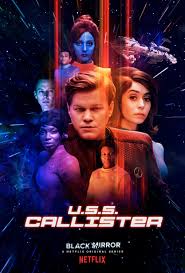
Black Mirror – USS Callister: if you’ve not seen this already I recommend you start with this before watching the season 7 finale. In fact, given that the original episode aired in 2017 it’s worth a recap as you probably don’t remember it all.
This was Brooker’s love letter to Star Trek; think Galaxy Quest but with a Black Mirror twist. As an unapologetic Star Trek nerd I adored this episode and the great performances therein.
It also gave Jessie Plemons the opportunity to do a pitch-perfect Shatner impression – honestly, it’s worth watching for that alone.
Black Mirror – Bandersnatch: As with USS Callister, this one is worth (re)familiarising yourself with, as it ties in with the season 7 episode, Plaything.
Now I know people who hated the Bandersnatch project, and I 100% understand why. You see, unlike the rest of Black Mirror, Bandersnatch is an interactive episode where scenes play out differently based on which option you choose.
As scenes progress you’ve given a choice and a menu to choose what happens next, and each choice you make results in a different outcome.
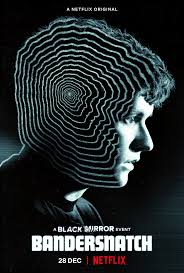
A cool idea, though too much for some. Getting to the point where two people agree what to watch on Netflix is problematic enough in the first place, without adding more choices throughout the viewing experience.
But, as someone who grew up in the age of Commodores, Speccies and choose your own adventure books, I found Brooker’s homage to the microcomputer era enthralling.
Bandersnatch is the Marmite of the Black Mirror universe. A surreal and psychedelic mashup of 80s nostalgia, ZX Spectrum games, Phillip K Dick and Tangerine Dream tunes.
Depending on how much of a nerd you are ,you’ll either find yourself questioning the nature of reality or wondering why the hell you put it on in the first place.
No prizes for guessing I’m in the first camp.
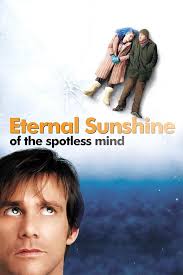
Eternal Sunshine of the Spotless Mind: I doubt I’m the first to compare the episode Eulogy with this 2004 masterpiece. Like Eulogy, it looks at relationship breakups through a sci-fi lens so, however fantastical it gets, the movie remains relatable at its core.
Eternal Sunshine of the Spotless Mind is also the movie which made me appreciate Jim Carey. I ignored him during the peak of his career, or at least tried to, as I found him extremely irritating.
So I was stunned to discover an actor I had for years associated with hyperactive scenery chewing was also capable of delivering such a muted and nuanced performance.
Eternal Sunshine of the Spotless Mind is one of those movies everyone should watch once (but invariably becomes one of those movies you return to again over the years.)
It’s a perfectly crafted sci-fi spectacle about heartbreak and the often insane lengths we go to try and avoid it.
Leave a Reply