
Starring: D’Pharaoh Woon-A-Tai, Will Poulter, Michael Gandolfini
Director: Alex Garland & Ray Mendoza
Year: 2025
Runtime: 1h 35m
Rating: ⭐⭐⭐⭐
Warfare is an Iraq War movie co-directed by Alex Garland (Ex Machina, Civil War) and former US Navy Seal Ray Mendoza.
Based on Mendoza’s real-life experience during the Battle of Ramadi, it stars Pharaoh Woon-A-Tai as Mendoza alongside Will Poulter and Michael Gandolfini.
The movie is notable for its kinetic cinematography and stripped-down approach to filmmaking, providing an immersive cinematic experience unlike any war movie to date.
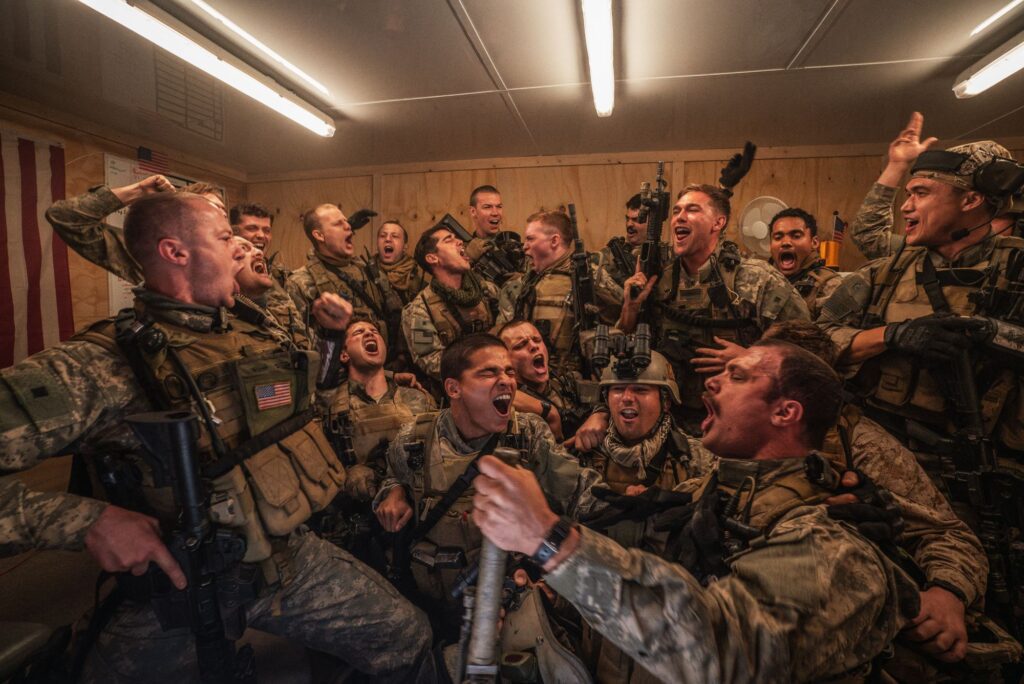
Briefing
Alex Garland is back with another war-themed movie and once again he’s not concerned about the plot.
Warfare has a start, a middle and an end, with clear shifts in tempo, but little else besides.
Don’t expect commentary, character or any semblance of story.
Instead brace yourself for an audacious cinematic simulation of war that’s utterly devoid of sentiment but is big on adrenaline, cordite and surround-sound firepower.
Warfare it promises – and warfare it delivers.
Oscar Mike
Garland’s last movie, Civil War, was A24’s biggest to date and created controversy for all the wrong reasons. Given the times we live in and the movie’s powder keg premise, one can be forgiven for expecting a cinematic milestone.
This is the guy behind Ex Machina and Dredd, after all, so when I first heard of the project, I was envisioning a true spectacle, something thought-provoking and subversive with the same cultural impact as the series V back in 1983.
Instead, we got, eeeh… what happened in that movie again?
Bar the few short moments Jesse Plemons is on screen – his brief performance being by far the best part of the movie – I honestly can’t remember much about it.
Texas and California are allies and marching on Washington for some reason, which makes zero sense. Their ideologically incongruous pairing is just one of the many convoluted lengths the movie makes to avoid anything which may be construed as social commentary.
The result was a visually stunning, yet conceptually hollow movie leaving audiences wonder, “Yeah but why?”
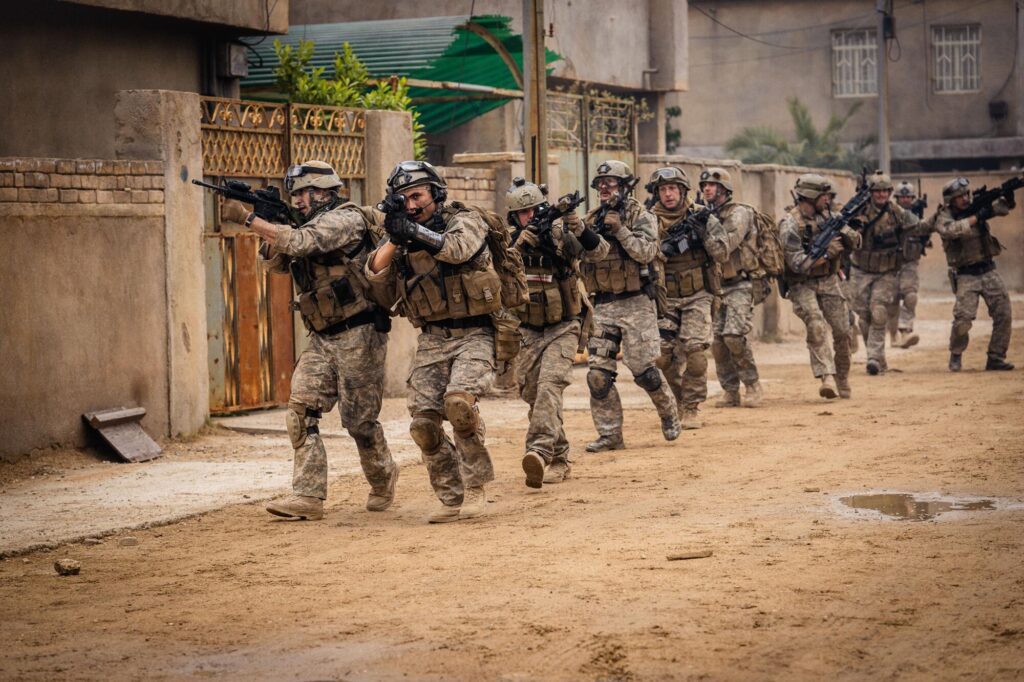
I say all this because everything I criticised Garland’s last movie for, I commend him for here.
For clarity, let me categorically state that Iraq was the greatest military blunder in modern history, an expensive and ultimately pointless parade of atrocities.
Or as Saddam himself might have put it, the mother of all shitshows.
But yeah, I know that, you know that and I’m pretty sure Alex Garland knows that.
So, do we really need his movie to lecture us about it?
Or do I really need to say “spoiler alert” when mentioning that Americans blow shit up, fire indiscriminately, terrify the locals, or get fucked up by IEDs?
We know all this, right? We watched the news; we don’t need the preamble.
So, kudos to this movie for skipping to the action.
But it’s not action movie action. At least not in the way you’ve seen before.
Warfare is a war movie in name only. More accurately, it’s a war simulation in movie form.
Garland’s approach rankles a lot of people who believe a war movie should always have a message, though having witnessed the on-screen carnage the message seems superfluous.
The other major criticism this movie has faced is that it’s a movie about the Iraq War with no Iraqis.
Which isn’t exactly true either. There’s one over there on that rooftop for starters, look? See him? Don’t poke your head up too high though…
Oh no wait he’s gone now. Oh, there’s another.
No wait, he lingered too long onscreen and got shot in the chest.
And it’s not just the rooftop wack-a-mole Iraqis either. We also have the poor interpreters who’d rather be anywhere else than Ramadi, plus hapless civilians held hostage in their own home.
True they don’t get a lot of screen time either. All they can do is tremble in terror as their home and lives are destroyed before their eyes.
What else can you do when a gang of gung-ho Yankies come bursting through your walls at 4 am armed to the teeth?
Not that the soldiers care. They’re there to do a job and the entire movie’s dialogue reflects this – every single word of it functional.
Warfare has no story to tell other than, “we were in this building and then this shit went down.”
Garland’s detached style of storytelling elevates the movie to the upper tier of what is, let’s face it, a rather crowded genre.
As for the lack of characterisation, who cares? These guys are Navy Seals, a specialised breed with a job that requires intense concentration, regimented movements and clear, unambiguous communication.
Bar the movie’s brief intro scene, the only palpable flash of humanity is when Michael Gandolfini’s character accidentally pricks himself with a needle and exclaims, “Oh shoot!”
His conscious decision to avoid profanity in the heat of battle while his comrade is shrieking for more morphine might be the most American thing I’ve ever seen.
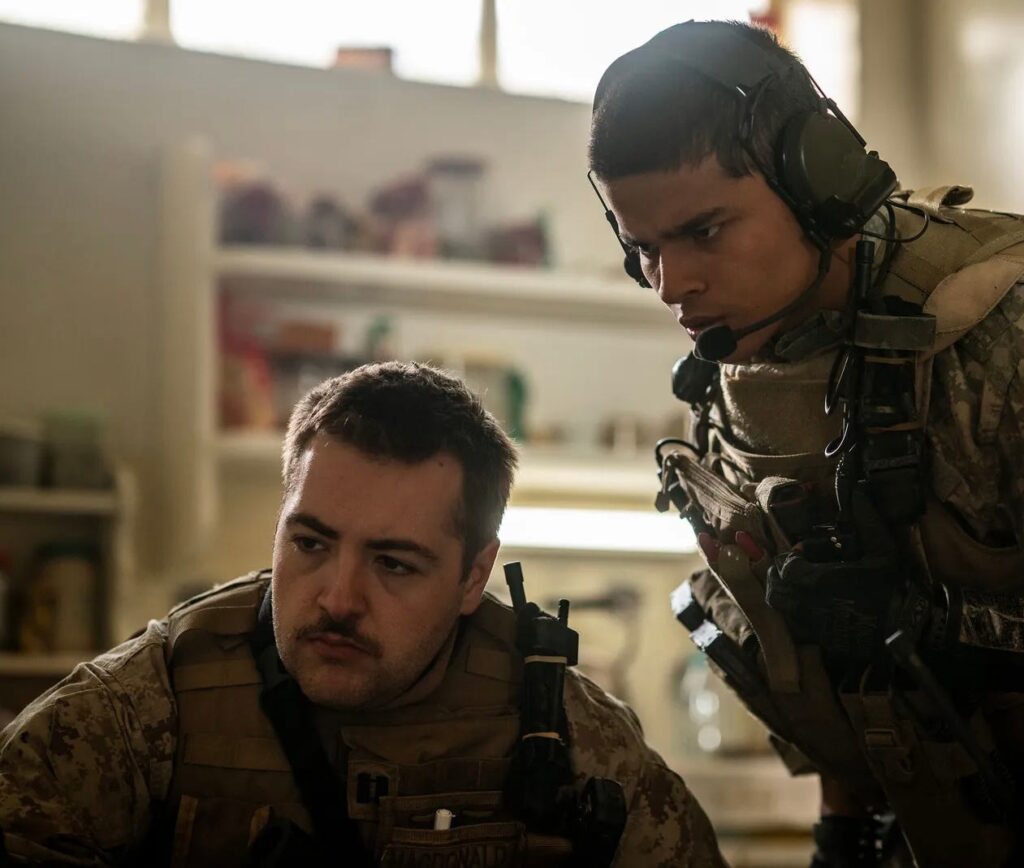
Gandolfini’s exclamation tells you everything you need to know about his character; he’s young, still a boy really, likely conditioned not to swear by his super-Christian upbringing, defending freedom, fighting the “evil-doers” – Baby Flanders with an M-16.
But that’s it, that’s your human moment, that’s your brief flash of humour, your chance to sit in the dark and speculate on a character’s motivations.
Other than those two short words, it’s all combat speak and radio chatter.
I pretended to understand more than I did until I realised I’d become so immersed I was growing fluent, as if my survival depended on it.
Only thing breaking the spell was some idiot in a squeaky chair.
Oh right, that’s my squeaky chair, leaning forward, trying not to munch my popcorn and instead rolling it around my tongue, willing it to dissolve quietly.
It’s hard to find anything to compare this to, though plenty reviewers have tried.
Blackhawk Down is the obvious one, and of course, there’s the Normandy Beach scene from Saving Private Ryan, the grandaddy of Dolby Surround shellshock.
The only other example I can think of was the one-take battle finale of Children of Men, except, again, it’s too stylised.
Warfare is not an anti-war movie. It’s an anti-war-movie movie.
It has no morals, no message, no plot. No hoo-rah flag waving, Hans Zimmer strings, slow-mo shots, no Ridley Scott sunsets and Drummer Boy bollocks.
No score whatsoever, in fact, because a score would trivialise the experience.
Instead we get some of the best sound design I’ve ever heard in a movie.
Similarly, we have no fancy one-takes, no clever blocking, no cool camera tricks.
Even brutal war documentaries like 20 Days in Mariupol seem like cynical contrivances in comparison because they’ve been edited down.
Whereas Warfare feels like we’re watching the raw feed.
But unlike Civil War, we’re not left wanting for answers. We don’t need the broader story because we know it.
Towards the end of the movie, one of the traumatised women captors emerges to find her home utterly destroyed, as the soldiers leave she screams after them, “Why?”
Except this time we already know the real answer.
The Good
Hyper Realism: Admittedly I can’t say whether this is realistic or not. It certainly seems so. Not being a trained babykiller myself I have no frame of reference, so what I will say is that Warfare contains some of the most visceral, yet least stylised combat scenes of any movie I’ve seen.
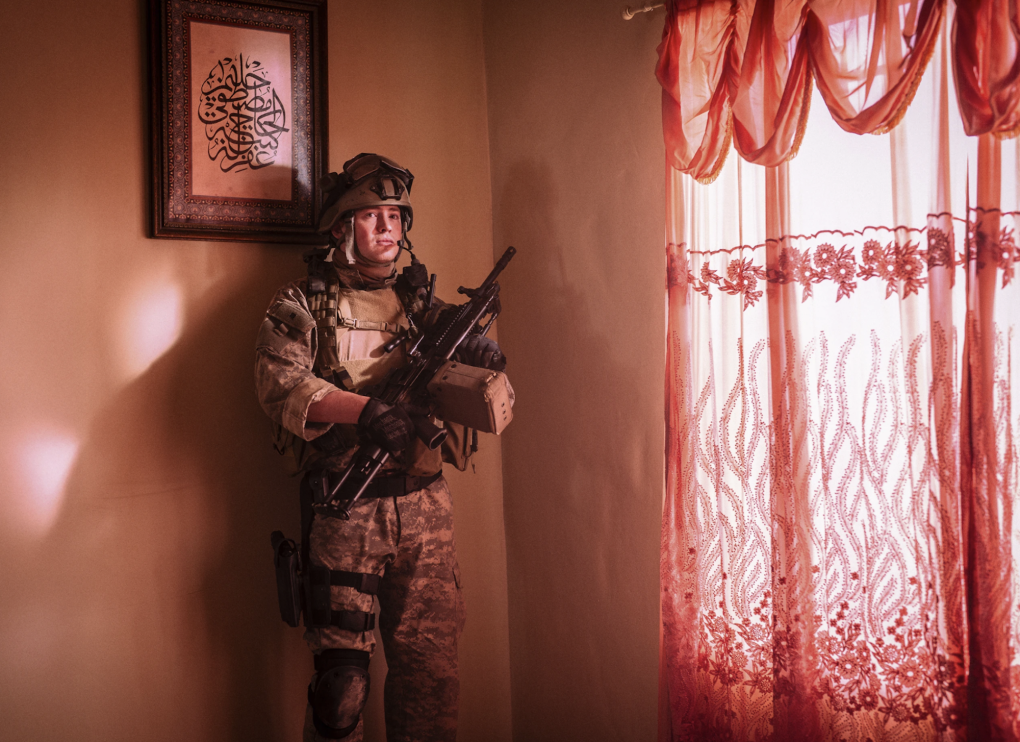
Sound Design: The movie’s sound does a lot of the heavy lifting, every shot, every ricochet, every deafening explosion is meticulously crafted to immerse you in the moment.
It deserves an Oscar for sound design and Garland deserves praise for his brave choice to make a movie devoid of a score.
Since Saving Private Ryan, the shellshocked soldier tinnitus EQ effect has become cliche. Warfare completely reinvents it in a way that feels like they’re pushing the boundaries of audio technology.
Combat-focused: Unlike Garland’s previous movie, which went out of its way to avoid taking a side, I applaud Warfare’s clinical objectivity. Having said that…
The Bad
Bush: The criminal hubris of the 2003 Iraq invasion is, was and always shall be unforgivable. An entire nation blown to bits – all to boost Halliburton’s share price.
Brutality: Warfare doesn’t simply show the realities of combat, it also vividly displays the consequences in gory, agonising detail.
The Evildoers
Taking Sides: While watching the movie I found myself mainly empathising with the poor civilians trapped amid the carnage.
The surrounding insurgents were little more than cannon fodder, but the Irishman in me 100% gets why they’re hell bent on repelling the imperial invaders.
Most our time, however, is spent with the US soldiers so we can’t help but empathise with them. We admire their resilience, trapped in this terrifying situation yet keeping their cool despite the odds.
But unlike the insipid jingoism of movies like Blackhawk Down or American Sniper, they’re not framed as flag-waving heroes, just professional soldiers with discipline and resolve.
Standout Scenes
The Shit Hits The Fan: The movie is split between pre-battle scenes and non-stop combat sequences. The dramatic fulcrum it all hinges on encapsulates everything wrong about the Iraq war in under five seconds.
Balcony Scene: It sounds romantic but trust me it’s not. It’s not even a major scene, a brief shootout on a balcony – but the aural intensity forces your mind to make judgement calls about how secure the cover is, subconsciously gauging the thickness of the concrete based on the bullet ricochets.
Seriously, if this movie doesn’t win the Oscar for best sound design someone needs to call in an airstrike on the Academy.
I Can’t Believe It’s Not Bradley: It’s an A24 movie, so I guess they can’t afford the real thing.
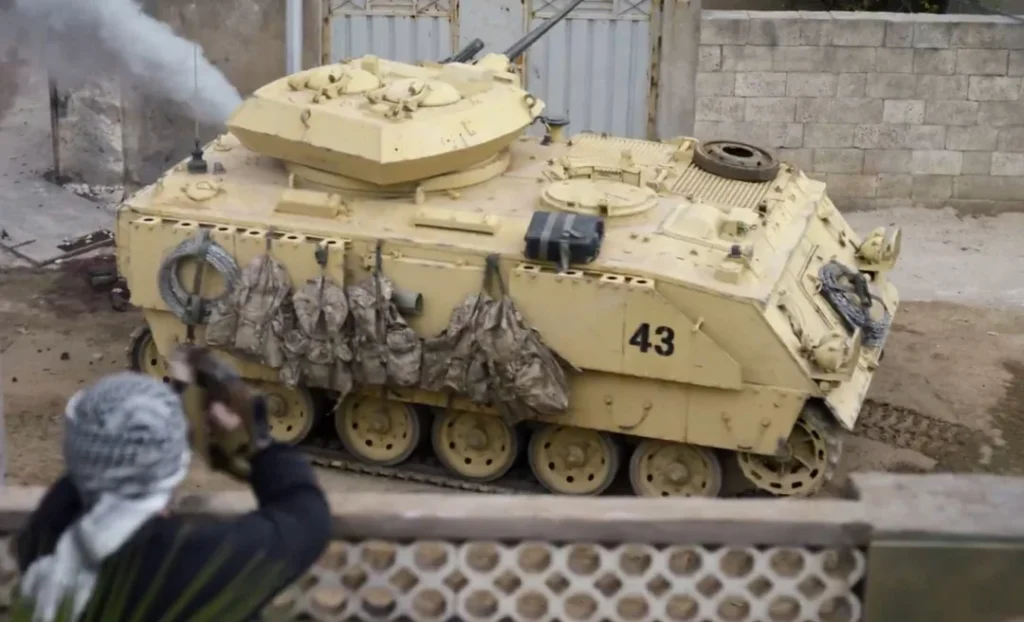
It’s fair to say the Pentagon wouldn’t lend Garland any without insisting he turn the movie into a recruitment video full of hoo-rah heroics and all that never-leave-a-man-behind band of brother bollocks.
I was none the wiser until my friend pointed it out they’re not real Bradleys. So it wasn’t a dealbreaker for me, on the contrary, when they start tearing up the neighbourhood it’s one of the most impactful scenes in the whole movie.
War Is Hell
There you go I said it.
If you need a movie to tell you war is hell, this ain’t it. It’s very much a show don’t tell hell on display here.
If you want a war movie with a message or one to fly a flag to, this ain’t it either.
Warfare doesn’t dramatize, demonise or glamorise, rather it attempts to depict combat as accurately as the medium of film will allow.
Yes, it does so from an American perspective, but that’s because it’s an American movie.
In an ideal world, we’d have a Rashomon-type film, telling the story from the perspective of the soldiers, those they took hostage and the swarming insurgents outside.
But I can’t see something like that ever getting greenlit in Hollywood.
Also Watches:
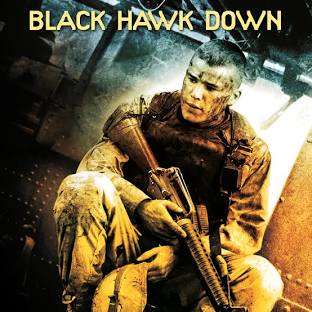
Blackhawk Down: Until Warfare, this, for me, was the gold standard for realistic depictions of urban combat. Set during the Somalian conflict, Blackhawk features explosive battle scenes and unforgettable helicopter strafing sequences.
It’s just a shame it’s sandwiched between two rotten slices of some of the most stomach-churning jingoistic American bullshit I’ve ever seen. But then Blackhawk helicopters don’t come cheap.
Story is, Scott was given the helicopters on condition he portrayed the US military in a heroic light. We believed that then, but in retrospect I’ve come to believe the added schlock was more Ridley and less Pentagon than previously thought.
Nonetheless, Blackhawk Down remains Ridley Scott’s last great movie before his eventual self-indulgent descent. It also has an excellent score by Hans Zimmer (who else?) at his absolute peak.
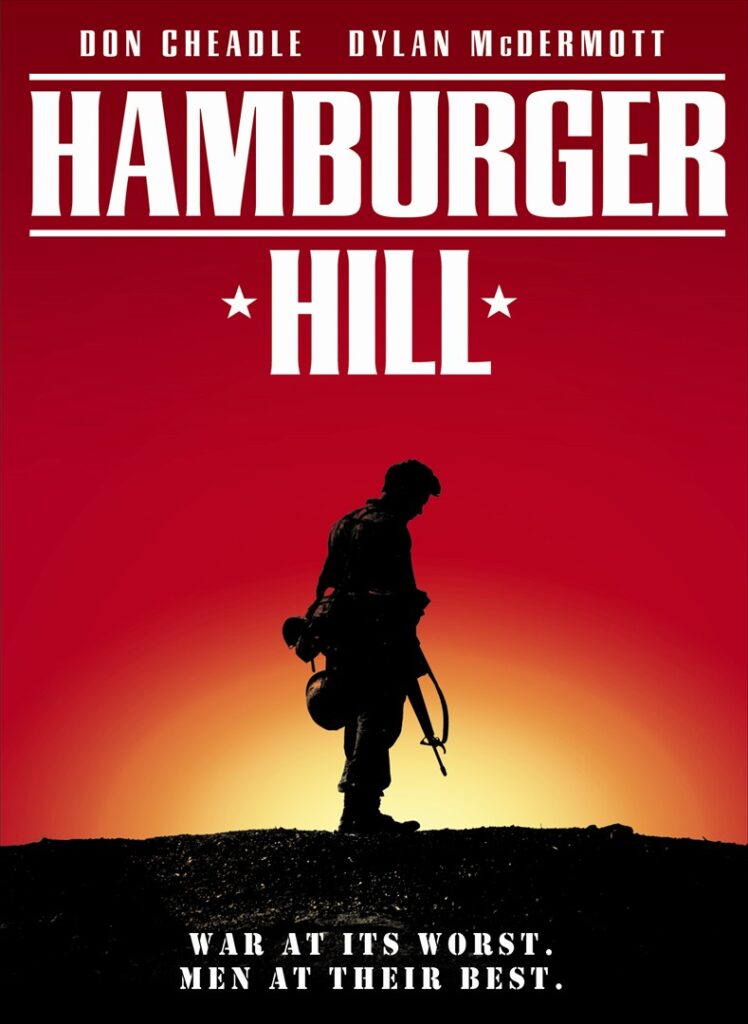
Hamburger Hill: Different era, different war – same shit.
Vietnam movies aren’t as popular as they once were in the 80s so this one gets overlooked in favour of better-known classics like Apocalypse Now, Platoon and Full Metal Jacket.
Great though those movies are, none manage to encapsulate the essence of the Vietnam war like Hamburger Hill.
Like Warfare, it conveys the brutality and futility of war, documenting a similarly pointless engagement which leaves you wondering, “Why?”
But it don’t mean nuthin’ – not a thang.
The movie is bookended by a nettling score from Phillip Glass which matches the mood of the movie perfectly, marching uphill, weary yet relentless.
Also, keep an eye out for a young Don Cheadle in one of his first movie roles, his on-screen presence is already unmistakable.
Hamburger Hill was a victim of timing, released the same year as Kubrick’s Full Metal Jacket and a year after Oliver Stone’s Platoon. Both classic pieces of cinema, no doubt, but as a straight-up war movie though, Hamburger Hill’s superior to both. </hot take>
Leave a Reply